Friday, August 12, 2022

An Interesting Radar Image


      It's been raining pretty heavily all morning so I didn't head out to my banding site. I was checking weather radar to see what this afternoon might look like when I noticed a really interesting image on the screen. All over the eastern U.S. I noticed the formation of what I believe are "roost rings" growing in size and then disappearing. These are radar images showing large flocks of birds rising up from their night roost to go off and feed.

If you look at Ohio on this image you will see 4 of these "rings". As far as what species this might be I'm not sure but my best guess is they could be Purple Martins and other swallows which are known to roost in flocks of up to 40,000 or more birds in some locations called pre-migratory roosts on their way south. It might also be groups of blackbirds which can form really large flocks. In some cases (not this one) it might also be insects or bats. Biologic returns on radar are fascinating and can tell us things we might not otherwise be aware of such as locations of these large roosts and the timing of movement by these large flocks.

There are still folks who argue that these images are either false returns or moisture in the air but not birds. I can assure you that radar ornithology has been understood for the last 50 years and is an extremely useful tool when it comes to tracking spring and fall migrations. So if you want to understand how useful this technology is you should check out the ebird related site called Birdcast, a great tool for birders.

Or maybe it's aliens....

Wednesday, May 4, 2022

Things are Getting to be More Springlike

 The weather here in Minnesota is finally starting to resemble true spring though it is still on the cool side and the trees have yet to break their buds. Some of the usual spring migrants are here in good numbers even if a week or so behind schedule.


Banding continues every day the weather allows. The wind died down today and my friend Mark came out to help at my banding site. This was the first bird of the day. It is a male Sharp-shinned Hawk and I seem to get one or two each year. Based on plumage this is a second year bird so after hatching somewhere north of here this fella made it south to their wintering grounds and is now headed back to the "homestead".

The most numerous species I've banded to date is the Ruby-crowned Kinglet. They should move on and be replaced by waves of warblers soon. When the winds switch to out of the south I think migration will explode here in the midwest. Be Ready!


Monday, April 25, 2022

A Cold Day for 2 Rare Visitors


Two White-faced Ibises have arrived at a great little wetland in southern Dakota County, Minnesota this week. They have been really cooperative for the many birders that trekked down from the Minneapolis/St. Paul area to see them. Cold wind and temps in the 30s did not deter everyone from chasing these two.

Along with the ongoing ibis there were other spring migrants around the marsh complex. Swamp Sparrow, Ruddy Duck, Northern Harrier and  Greater and Lesser Yellowlegs are among the first of year birds for me today. If the winds ever change direction and bring us warm weather I expect things to progress rapidly. Not too rapidly I hope. 

Banding has yet to pick up to the point that I am getting out every day but I did band yesterday and had nice FOY birds such as Brown Thrasher, Northern Waterthrush, Orange-crowned Warbler and Lincoln's Sparrow. I can't help thinking about what I might be missing because of the weather. Anyway, get out when you can and...

Keep looking up!


Saturday, April 9, 2022

Spring Banding About to Start

 It has been a long winter and an even longer spring but the weather looks to be favorable for at least getting into the field and putting up some nets.


Tonights Doppler radar shows a good movement of birds up the central U.S. mainly along the Mississippi basin. With this many birds in the air there should be new species showing up in the area by morning. Southeasterly winds will make tomorrow breezy.


The Birdcast image from 10:15 Central Time estimates over 124 million birds in the air over the U.S.. Both of these maps give me hope that tomorrow will be more active in the field than the last couple of weeks. New birds are showing up in small numbers but the next 3-4 days should see that change.


Good Birding and keep looking up.

Tuesday, November 30, 2021

 Well it has been a while since I've sat down and updated the blog but lots was going on this summer besides the pandemic chaos. I spent over 100 days in the field banding and am still working on wrapping up the records for this season. I'll post more on that later.

What I'd like to talk about today is a rare bird that showed up in Minnesota 3 days ago. A Ross' Gull, which is a far northern species usually seen in Alaska and Siberia, somehow found its way to a sandbar at the confluence of the Mississippi River and the St. Croix River at Prescott, Wisconsin. Prescott is just across the river from Washington County, Minnesota at Point Douglas Park.

                                             Juvenile Ross' Gull at Point Douglas Park, Minnesota

I'm not one to make a habit of chasing rare birds but this is a bird that I would never have expected to see in Minnesota, if ever. When it shows up so close to home though I had to make the attempt. This is a really cooperative bird and seem unfazed by all the people looking for it. It spends most of the time on the water under the railroad bridge that crosses the river or on the sandbar that is formed on the Minnesota side of the river. The only thing that seems to agitate the bird is the trains that rumble across the bridge occasionally.

Yesterday the birding gods were smiling because not only did I get great looks at the bird, the weather was unusually warm and sunny. It was the perfect day to look for birds, not just mega-rare birds. As we birders are getting ready to wrap up the year lists from 2021 and start a new one on 1-1-22 it's nice to add a tick or two on the checklist so late in the year.

The bird has stayed for 4 days now so if you haven't had a chance to get down to see it you still have time.


Wednesday, March 3, 2021

Sax-Zim Bog


In spite of the really harsh cold snap we experienced in February, the weather in March has been quite pleasant (at least for the first 3 days). I decided to make the annual pilgrimage to Sax-Zim Bog before the northern visitors left for the year. Some birds like this Black-backed Woodpecker are year round residents but hiking through the bog is easier in winter so getting a nice look at this species is usually a winter experience.

Some birds do stay year round and are easy to find near feeders, particularly suet feeders or in this case the rib cage of a deer that was set out just for Canada Jays and Boreal Chickadees. Canada Jays recently had their name changed (reverted back) from Gray Jay. It was selected by the people of Canada as their national bird.

A couple of species that were targets for this trip were Evening Grosbeaks and Pine Grosbeaks. This was a very good year for Evening Grosbeak reproduction and I saw more this trip than I had in a long time. Back in the day when I was in college and just starting as a birder this species was the most common bird at the feeders on campus in northern Wisconsin. Their population has taken a real dive in the last 30 years and there is no one clear reason for it. Needless to say, seeing them brought back a lot of memories.

Pine Grosbeaks have been a more regular species at the feeders in the bog on previous trips. They mingle in mixed flocks with the Evening Grosbeaks and sometimes Common Redpolls. The birds were quite "chatty" the entire time I was watching them. The daylight length is getting longer and is triggering spring breeding behavior. Locally we have gained around 2 hours of daylight since the winter solstice and each day adds 3 more minutes of sunlight.


If you have never had a chance to get to Sax-Zim Bog in northern Minnesota it is a trip worth making. In fact it is a trip worth making several time over the year. Winter specialties include northern owls, most notably Great Gray Owls and Northern Hawk Owls. Summer is good for nesting warblers including Connecticut Warblers. Spring is a good time to look for Sharp-tailed Grouse and Fall migration can produce almost anything if you're in the right place at the right time. 

Even if you can't make it visit the website for the area and see what you're missing!

Saturday, June 6, 2020

Doing a Double-take

Sometimes when I'm banding I'll catch a species of bird I've never handled before and that can be both exciting and frustrating. Then there are the birds I catch that I have handled before but one individual is different enough to give me pause. I had that experience recently when I walked up to one of my nets and pulled out a bird that made me say "What the...."

Here's a close-up:
The neck band was something I had never seen. However, once I looked at the whole bird, it was actually more obvious than you might think. If you look at the whole bird it can only be one species.

Take a look:
The whole body view tells you this is obviously an American Redstart. At first glance the thought is what an odd looking female...but it's NOT a female. This is a second year male. It takes males 2 years to get their complete black plumage. Second year males can show all sorts of odd patterns of spots and blobs of black feathers that are not consistent. I've never seen a second year male that shows a neck band like streak of black feathers.

What a cool bird. This is an individual I would love to catch again and see how the next molt makes him look. Should be a normal male Redstart plumage.

Remember, just because something doesn't look exactly like the field guide picture doesn't mean it's a hybrid or a previously undiscovered species.

Wednesday, May 13, 2020

The Birds Have Finally Started Arriving

The weather forecast sounded good. The prediction on Birdcast looked great. Was it finally time for a great migration movement here in Minnesota? I got up and checked the radar at 5:30 this morning and it did not disappoint:
All those pretty colors represent thousands and thousands of birds streaming into Minnesota and getting ready to, hopefully, land in my backyard!

This was too good to pass up so I jumped in my van and headed to my banding site.  For once my expectations were met and I spent the next 9 hours banding a variety of birds, many of whom had just landed minutes before.

 There are still some sparrows moving through and some of them will stay to nest. This Field Sparrow is a common grassland resident here with a call that sounds a bit like a ping pong ball bouncing on a table.
A species that is just moving through the area is the Lincoln's Sparrow. Identified by the finely streaked buffy chest.

A surprise for me is not this Ruby-crowned Kinglet but is how many I have seen and banded. I don't think I've ever had this many kinglets for so long.

 Of course, for lots of people spring migration is all about the warblers. Well today they made an appearance in good numbers. Above is a Nashville Warbler which is one of the earlier migrants.

 The first Wilson's Warbler of the spring was this male. Only one graced my nets today but there should be plenty more behind him.

The most numerous warbler of the day was the Palm Warbler. There were so many that when they passed by it was like decorations on a Christmas tree. Spots of yellow and bouncing tails all over the place.


 And finally this handsome bird. A Yellow Warbler who flits from branch to branch proclaiming "Sweet, sweet, I'm so sweet!" I re-trapped one individual exactly 2 years to the day from when I first banded it. Based on data I have for this bird it is at least 4 years old.

Below is a summary of the species and numbers of each that I banded today:

American Redstart              1
Nashville Warbler.              3
Ruby-crowned Kinglet       4
Wilson's Warbler                1
Palm Warbler                     8
Field Sparrow                    1
House Wren                       2
Yellow Warbler                 5
Common Yellowthroat      2
Black-capped Chickadee  2
Lincoln's Sparrow             4
White-throated Sparrow   6
Rose-breasted Grosbeak   1
Gray Catbird                     2
Bluejay                             1


Thursday, February 13, 2020

A Trip to Sax-Zim Bog

I decided to take a run up to the Sax-Zim Bog area of northern Minnesota last week to take advantage of good weather and to avoid the visitors arriving the following weekend for the annual Sax-Sim Bird Festival. There were some good birds around and I wanted to see them without having to fight the crowds.

I wasn't disappointed even though I didn't see all the species I had expected.


I was by myself when I ran into some cooperative Canada Jays foraging along one of the road sides. They didn't seem to be bothered by me as I tried to get close.


I got real nice views of the birds at the feeders along Admiral Road along with the regulars like Black-capped Chickadees and Red-breasted Nuthatches.


The "best" birds of the day were the owls. While Sax-Zim is famous as a location to see Great Gray Owls but I didn't luck onto one of them that day. I did observe a very nice Barred Owl hunting mice below the bird feeders at the Winterberry Bog location. In spite of there being an audience, this bird was successfully hunting.


The real gem for me for the day was this Boreal Owl. It had been a very dependable bird at a feeder station and I was glad to see it still there. While I was getting these pictures, I ran into 4 other friends at this location that I didn't know were coming to the bog. It can be a pretty small world at a good birding site.

I saw 2 other owl species but didn't get good photos. Snowy Owl and Northern Hawk Owl gave me a total of 4 owl species for the trip!

I also had a lot of the usual feeder birds like this Hairy Woodpecker. Also saw Red-breasted Nuthatch, Downy Woodpecker and Bluejay BUT didn't see any grosbeaks, Pine Siskins, Common Redpolls or Boreal Chickadees.

I did see Black-backed Woodpecker and Black-billed Magpie late in the day.

If you have the chance to get to the bog there is probably just another 3-4 weeks left before these winter visitors head back north. Don't put off your visit!

Tuesday, September 10, 2019

The Migration Continues

I've had the great fortune to be able to get out into the field quite a bit in the last week. Radar returns at night have shown very heavy migration movement lately and the birds in the nets back that up.

New species for the fall are showing up in numbers. Ovenbird, Swainson's Thrush, Red-eyed Vireo and all the flycatchers have been increasing in abundance this week.


 Mourning warblers have been fun to work on daily. This male looks like he has a bit of attitude but he was calm during processing.
Northern Waterthrush is a pretty common migrant in spring and fall. Caught this one in a forest/grassland edge, not near water which is more the case usually.
Sparrows move through this part of Minnesota mostly in the month of October but we do see some early movers like this Lincoln's Sparrow.
The highlight of Sunday's banding was not one but two Yellow-throated Vireos. In spite of the cool temps and off and on rain we had some nice birds but none was as exciting as this bird.

The weather for the next 2-3 days looks to be poor for field work. Rain and wind are predicted until Saturday. Another glitch in the system is that the National Weather Service Doppler Radar in Chanhassen, MN has be shut down for maintenance (they're replacing the radars base). Not sure we'll be able to check night migration for a week or so. Might have to go outside and just listen.

Monday, September 2, 2019

Fall Migration is Ramping Up

Had a chance to spend 4 of the last 5 days banding out at one of my sites and boy was it fun. Thursday the 29th was sunny, warm and windy so I only caught one bird before I bagged it and went home. Friday was better with 6 birds for the day. Saturday was perfect as far as conditions go. It had the 3 Cs of banding: cloudy, calm and cool. My friend Amber was there to help and we end the day with 30 birds of 14 species including 5 species of warbler. Took Sunday off and headed back out this morning. Not as busy as Saturday but we (help from Amber  Chris and Laurie) did get 12 birds. We also had some nice flyovers from things like Common Nighthawks (~40), American White Pelicans, and any number of migrating songbirds that weren't low enough to hit our nets.

Here are a few pictures from the weekend:

 We don't handle a lot of Mourning Warblers usually but did get both this male and the female below. It's always fun to walk up to the net and see lots of yellow.
 Ageing these birds can be a bit tricky so we tend to spend a little more time with them than some of our regular captures like chickadees and catbirds.
 A common summer resident around here is the Blue-winged Warbler and we do catch a few of these both during migration and breeding season.
 A very common summer resident is the American Redstart. This male has just molted in its plumage for the winter.
While I was away from the banding site I caught a photo this visitor on my trail camera that monitors the site. A small set of antlers still in velvet will being changing in the next couple of months.

Tuesday, April 30, 2019

Birds Crossing Gulf of Mexico in Big Numbers

This is a radar image of the Texas gulf coast. From the returns it appears that there are large numbers of birds arriving along the coast today. The surprising thing to me is that it is midday so these are probably birds that have been flying all night just getting to land. If anyone is in the area and can get out, it would be interesting to know if this is an indication of a true "fallout" of migrants.

If nothing else, it means that those of us to the north can still expect a big influx of birds sometime in the next week or so I would imagine.

Texas birders - you out there?

Sunday, January 13, 2019

Water is a Magnet for Birds

After a slow few weeks of activity in my yard, i was amazed today when I had a crowd of birds hanging out most of the day and it all had to do with water. I have a heated birdbath on my deck and as soon as I filled it up today the birds came in like nails to a magnet.

The first birds in were a flock of robins that had been in a neighbors yard. There was such a competition for a bath that some of the birds got belligerent.
Even birds can be bullies I guess.
 A couple of cardinals waited their turn with patience.
Lots of American Goldfinches took advantage of the water. It also looks like they are beginning their spring molt. A few of the males are showing patches of black feathers on their foreheads.
I was very happy to finally have some Pine Siskins show up in the yard. I know a few friends who have had them for a while but today was the first I had them around.
One Cedar Waxwing showed up and only stayed a few minutes.
I even had this Northern Flicker come in to take a turn in the birdbath. All in all I ended up seeing 18 different species of birds in the yard today. I hope they stick around a while longer, they made it sound like spring .

Sunday, November 11, 2018

How Many Field Guides Do You Own?


 Let me start by saying 2 things. First, I cannot answer the question posed in the post title. I have more field guides spread through my house than I can count. I have a hard time getting rid of books in general but field guides are never disposed of. Second, I LOVE field guides, including from places I may never visit. I prefer guides whose illustrations are paintings and not photos. I know not everyone agrees. The first field guide I ever owned was the Golden Guide to Birds and it served as the "textbook" for my first field ornithology class.

I still have it.

When I heard there was going to be a seventh edition of the National Geographic Field Guide to the Birds of North America I was excited to see what was new because this is the guide I carry in the field. At first glance it is very similar to the previous additions, it covers all of North America, it is a bit larger than many guides, it is heavy by field guide standards and a Bald Eagle is featured on the cover. However a closer looks shows some significant advances. Here is how the publisher describes it:
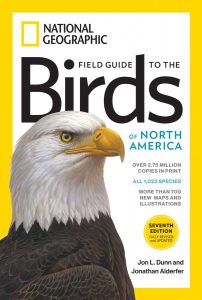
 

About Field Guide To The Birds Of North America


ï Paperback:†592 pages
ï Publisher:†National Geographic; 7 edition (September 12, 2017)

This fully revised and updated edition of the best-selling North American bird field guide is the most up-to-date guide on the market.

Perfect for beginning to advanced birders, it is the only book organized to match the latest American Ornithologists' Union taxonomy. With more than 2.75 million copies in print, this perennial bestseller is the most frequently updated of all North American bird field guides. Filled with hand-painted illustrations from top nature artists, this latest edition is poised to become an instant must-have for every serious birder in the United States and Canada.

The 7th edition includes 37 new species for a total of 1,023 species. Sixteen new pages allow for 250 fresh illustrations, 80 new maps, and 350 map revisions. With taxonomy updated to recent significant scientific rearrangement, the addition of standardized banding codes, and text completely vetted by birding experts, this new edition will stand at the top of the list of birding field guides for years to come."


It's all this and more that will keep the National Geo guide as my go to book in the field. The book is reflective of our new knowledge about bird taxonomy based on DNA sequencing. A geneticist I know said that in 10 years we won't have to buy any new field guides because the taxonomy will be all figured out. We'll see. The new taxonomy has its pluses and minuses. I am excited to see the subspecies maps at the back of the book but the concept of subspecies is still being worked out (how many subspecies of Song Sparrow are there???)  The rearrangement of the order of bird families is something to get used to. If you are good at flipping to specific sections of the guide without thinking about it you may be surprised where you land now.

As a bird bander myself the addition of the Bird Banding Laboratory 4-letter species codes is nice to see though I don't know how many people will use them as shorthand. In some birding groups people get upset if your mention an AMRO instead of saying or writing American Robin. I did find one error in the codes, the banding code for Yellow Warbler has been changed to YEWA whereas the guide lists the old YWAR. I don't know of any other errors.


It is a beautiful book with useful, detailed illustrations and descriptions. I recommend it as a top choice when friends ask for advice about buying a field guide.
You will not be disappointed.


Social Media
 #fieldguidetothebirdsofnorthamerica     @tlcbooktours.


Purchase Links


National Geographic | Amazon | Barnes & Noble

Sunday, November 4, 2018

Field Season Comes to an End

Well it was a good year for banding and I got out as much as I could but it looks like the weather is going to keep me away from the banding site for a few months. I did get out on Saturday before it began to rain and actually had a nice morning though it was pretty quiet most of the time. I ended with 11 birds of 4 species. Two birds were retraps (chickadees).

Totals:

Black-capped Chickadee      5 new  2 retrap
Dark-eyed Junco                  1 new
American Tree Sparrow        2 new
Northern Cardinal                 1 new


I especially liked getting the Am. Tree Sparrows. I think they are just beautiful!
These really say "winter" to me. They are tough little birds.
The bicolored bill is always a good field mark.
And of course the junco is the most common sparrow here in the winter. This male had quite a bit of stored fat so he may not be quite to his winter vacation spot jut yet.

I'll keep posting bits here and there. The Christmas Bird Count is coming in a little over a month. Northward migration will begin in January.

Remember, year round there are always birds migrating somewhere in the world!

Wednesday, October 24, 2018

The Splendor of Birds


In celebration of "The Year of the Bird" on the 100th anniversary of the Migratory Bird Treaty Act, National Geographic has published a 500+ page book of photographs and paintings called The Splendor of Birds.

The Splendor of Birds is a collection of images from around the world as seen in National Geographic Magazine over the last 130 years. These images in this book are divided into 4 chapters that are organized chronologically. There are short introductory essays at the beginning of each section and they reflect what was happening at National Geographic during each time period and how birds played a role in the mission of the magazine.

When I had a chance to look through the book the first time I was impressed by the variety of images. Being a bit of a photographer myself, I could appreciate the time and effort many of the photos required especially in the days of physical film. The paintings included in the book are from some of the great bird illustrators of the day. The turn of each page presented images that ranged from spectacular to ordinary.

As I browsed through the book I tried to think of how I would describe it to someone. Was it art?, history?, photography? all of the above? It certainly could qualify as a coffee table book, something as much for display as it is for perusing. I realized that after looking through the book I had lots of questions. How were the images chosen? Was there a common theme beyond "birds" that described sets of images. Why were the time periods arranged the way they are? I couldn't make a connection between that chronology and other events that might have made the periods relevant.

There is a feature of the book that I like and that is a variety of facing pages labeled "Now and Then" where the picture on the left is an older photo of some bird and the picture on the right page is a more modern image of the same species. The comparison aspect is a nice touch.

However the more I looked through the book the more criticisms I had.

I found the captions of many of the images too small and less than informative. It would be nice to have more context about many of the images. Some of the images included are more focused on people or places than birds. Many selections feel as if they were chosen randomly and I  didn't find the book to have a good "flow" in it's presentation. Finally, for a book that costs $75 I would want a book that would draw me back over and over again to get a deeper appreciation for it's content. I don't know if this is that book.

So, would I recommend this book? That depends. I certainly think many people would enjoy this book and having a collection of beautiful images  to look at again and again might just be the thing when you're in the right mood. Is it worth the cost? I believe that is something that each reader must decide for themselves. Am I glad I have it? Yes and you might be too. If you are curious, it would be worth your time to look this over and see if it resonates with your love of birds.


Saturday, October 20, 2018

A Cold. Windy Saturday for Banding

We held our regular monthly banding program at the Lowry Nature Center in Carver Park Reserve near Victoria, MN today and despite the cold and wind had a slow but productive day.

It's always nice to be able to work in a beautiful setting and the maple trees today were quite lovely.
As I said the biggest problem we had today was the wind. We were restricted to using only Potter traps which tends to lower the number of birds we handle. We ended the session with 12 birds of 5 species which was better than I thought we might do.

Today's list:

Black-capped Chickadee        4
Dark eyed Junco                     5   (3 new, 2 retraps)
American Goldfinch                1
White Crowned Sparrow        1
White breasted Nuthatch        1


The interesting catches of the day included this very young male Northern Cardinal.
The bird must have been a relatively late hatch (second or even third brood). The dark bill should be light by now.

A bird we don't catch very often was this White-crowned Sparrow. A really beautiful bird in the hand.
A close-up shows nice detail of it's head.
And just to prove that winter is right around the corner, we had lots of Dark eyed Juncos around the feeders including this nice dark gray male.
The plan is to try and do some banding Sunday morning as the winds are supposed to diminish and the temps should be a bit warmer. I'm still able to get into the field right up until it snows as long as there are birds around. Sparrows are here in good numbers and last week 2 very late Parula Warblers were seen near a lake in Minneapolis. You never know what might show up so keep looking up.