Sunday, August 22, 2010

As Summer Fades, Migrants Appear


After a long summer of not getting out much and obviously not posting anything here, yesterday was the first banding session of the fall where we had a number of obvious migrants moving through the area. This Canada Warbler was just one of 5 warbler species we banded.

The morning started off like a bad B-horror movie with thick fog everywhere. For banding though that's not so bad. It means there is little if any wind and the birds tend to stay lower in the vegetation. We hoped for a good day and we got it.


A feisty Rose-breasted Grosbeak always leads to an arguement over who gets to take it out of the net. This female was everything a grosbeak is supposed to be like - loud, mean and looking for any opportunity to try and draw blood. She is beautiful though. The bright yellow underwings almost glowed.


One of my favorite fall warblers is the Chestnut-sided Warbler because it looks like a completely different bird than the ones we saw in May. This one kept flashing it's tail while we took pictures before letting her go.

All in all it was a very busy day. We started the session a little before 0800 and didn't finish up until 1330. The last run of the nets brought 18 birds into the station at once so lunch was a bit later than normal.

The totals are as follows:

Tennessee Warbler - 6
American Redstart - 2
Chestnut-sided Warbler - 1
Nashville Warbler - 1
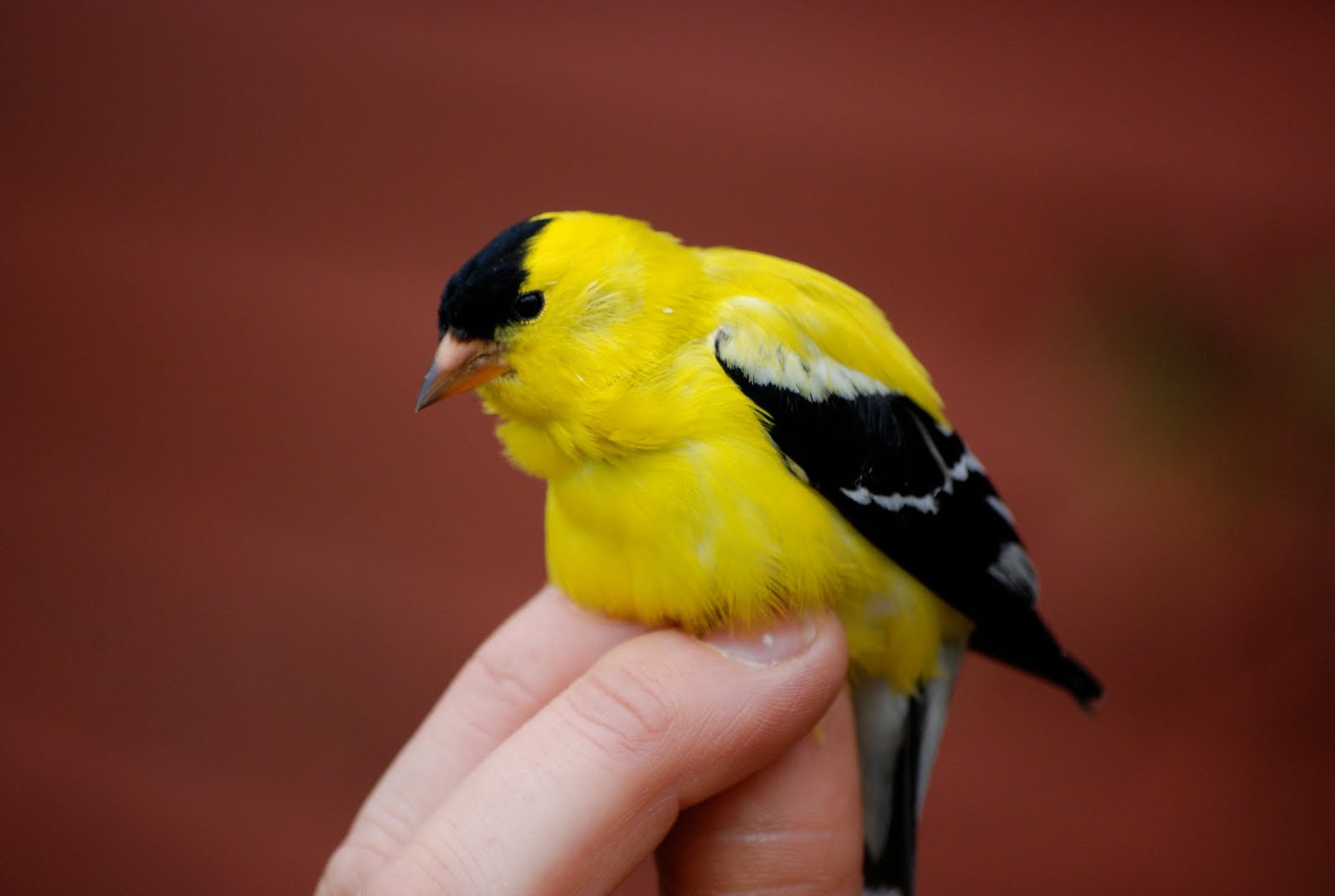
American Goldfinch - 16
Black-capped Chickadee - 10
Canada Warbler - 1
Eastern Wood Peewee - 1
House Wren - 1
Indigo Bunting - 1
Red-eyed Vireo - 4
Gray Catbird - 1
Rose-breasted Grosbeak - 1
American Robin - 1 (missing it's left foot)

Total species = 14
Total Individuals = 47

A busy, busy day...

Friday, May 28, 2010

Busy Birding Week


I've been very busy this week teaching my Field Ornithology class and having a great time doing it. Trouble is I come home just knackered at the end of the day.

I'm headed to the north shore of Lake Superior in the morning to see if I can catch up to some of the birds that have already passed through my neck of the woods.

Thought I'd give you one photo as a tease for all the rest I promise to post when I get home from up north. Until then...keep looking up!

Saturday, May 22, 2010

Migrants Still on Their Way


The radar images from Saturday night show that there are still many migrants on the move especially in the lower Great Lakes all the way into places like Missouri, Illinois and Indiana. For all of you despairing that the migration might be over, the only place that looks like they're into summer is the far south. Movement there is pretty quiet.

The storm system that has affected the midwest for the last few days has finally moved on an that means the floodgates might be open, that's what we hope for anyway. Banding tomorrow should tell us whether we still have birds arriving in Minnesota.

Friday, May 14, 2010

Banding Programs This Weekend

There will be 2 programs this weekend for bird banding in the Twin Cities area.

Saturday we will be banding at the Lowry Nature Center located in Carver Park Reserve just west of Victoria, Minnesota from 8 - noon.

Sunday we will be banding at Ritter Farm Park in Lakeville, Minnesota from 9 - 1 as part of their celebration of nature event.

Both programs are free and open to the public. If you come out to visit make sure you bring your camera. I think it should be a good weekend for birding!

Tuesday, May 11, 2010

Weekend Banding Totals


Saturday was so much fun that I dragged myself out of bed again on Sunday and went up to school to see if I could add to my totals for the weekend. The weather was considerably better with lots of sun and a light wind. This is how banding should be.

The birds were around but I didn't catch as many as the day before. I did have a couple of "good" birds for the year. The first bird of the day was a Swamp Sparrow on his way through but the really exciting bird was the little girl pictured above. This is my first Blue-gray Gnatcatcher ever. They are incredibly small and their legs are like toothpicks. We've been hearing a lot of these birds around but they're usually up in the tops of trees, not anywhere near my nets.

May banding is off to a nice start. For the weekend I had 38 individuals of 15 species. The list is as follows:

Blue-gray Gnatcatcher (1)
Chipping Sparrow (4)
Black-capped Chickadee (3 new, 2 retraps)
American Goldfinch (2 new, 1 retrap)
House Wren (1)
Pine Warbler (1)
Swamp Sparrow (1)
Downy Woodpecker (1 new, 1 retrap)
White-breasted Nuthatch (3 new, 2 retrap)
White-throated Sparrow (4)
Northern Cardinal (1 retrap)
Hairy Woodpecker (2 new, 1 retrap)
Rose-breasted Grosbeak (2)
Red-bellied Woodpecker (2 new, 1 retrap)
American Robin (2)

Next weekend we will be doing 2 programs. Saturday we will be at Carver Park Reserve near Victoria, Minnesota doing our monthly banding program for the public and on Sunday we will be at Ritter Farm Park in Lakeville, Minnesota doing a banding program during the cities spring nature festival.

Drop by and say hello if you can!

Monday, May 10, 2010

Banding in Wisconsin


I have a chance every so often to head over to a site in Wisconsin with Birdchick and another friend to do some banding at a great piece of habitat not far from Menomonie, Wisconsin. With the beginning of migration finally picking up I was excited to put out some nets until it started to snow on the drive over. Low overcast with wind and rain/snow is probably the worst when it comes to banding. However, with the chance that the front would come through and clear the sky we persevered and had nets up by 8 am. The rain held off for the most part and the wind varied so we stuck with it and were rewarded with 31 birds of 12 species.


There were several Rose-breasted Grosbeaks, Pheucticus ludovicianus, coming to a feeder station and we caught 2 beautiful males. It was worth it despite the finger numbing bites these fellows can inflict.


A brush pile turned out to be a great spot for a net and there were still some White-throated Sparrows, Zonotrichia albicollis, hanging around. We heard them all morning but didn't catch any until later in the afternoon.


One of the better catches of the day was this Pine Warbler, Dendroica pinus, and we might not have caught it if Birdchick hadn't set up a warbler chip call recording near the net. It was pretty effective in drawing the bird in quickly.

By the time we took down our nets the sky was clearing and the temps were rising. We can always count on working hard when we band at this site but it is always worth it.

Saturday, May 1, 2010

Storm Fronts Slow Migrants

Two strong storm fronts moving across the eastern U.S. have slowed migration pretty much everywhere behind the fronts. Good movement is indicated ahead of the storms, particularly in the far southeastern U.S.


As these fronts pass migrants should be grounded after not having moved a great distance. Any migration behind the fronts should be light.

Friday, April 30, 2010

This is Gonna be Bad

As more and more information becomes available about the oil spill in the Gulf of Mexico, the gravity of the situation is really becoming obvious. To compound the worries, this is the peak of cross gulf migration and the radar maps from this morning showed what appeared to be a pretty heavy landfall along the coast.


This is a NASA satellite photo of the spill as it sits off the coast.


This radar image from CONUS shows heavy returns along the coast this morning and and a look at the loop image indicates movement inland. Hopefully, most migrants will land far enough away from the coast as to be unaffected but right now lots of breeding coastal birds are in for a tough time.

The New York Times has a good article that discusses the potential (inevitable?) impact on wildlife along the coast.

I would be curious to hear from birders along the coast as to the arrival of migrants today along the Gulf Coast.

Monday, April 26, 2010

Bird Banding Bust

The weather really did us in yesterday. A constant rain and wind combined with cool temperatures resulted in no birds caught during our program!

None

Nada

Zilch

Bupkus

sigh......

However I have great hopes for the weather changing later this week and starting those migrants moving again. It is, after all, still April.

Friday, April 23, 2010

First Banding Session of the Year at Ritter Farm

We will be holding the first of 3 banding sessions at Ritter Farm Park in Lakeville this Sunday if the weather isn't terrible. Hopefully the predicted rain for Saturday will be over by the time we need to set nets. If it's just misty we will go ahead with the banding. The program is sponsored by the city of Lakeville and there is a $2 fee for adults, kids are free.

Anyone interested will find us down in the Gazebo by the lower parking lot. Directions to the park are a bit tricky. If you are coming to the session this should get you there:

From the Twin Cities -
South on Interstate 35 to 185th St exit.
After exiting turn left (under highway) and go to next stoplight.
Turn right at stoplight onto frontage road.
Follow road to 195th street (bridge)
Turn right (back across highway) and turn right on gravel road into park.
Where road splits, go to lower parking lot.

From South -
Take Interstate 35 north
Exit at highway 70 (the famous McStop)
Turn right and go to stopsign for the frontage road.
Turn left and go to 195th St
Turn left across the bridge and then right onto gravel road into park
Where road splits, go to lower parking lot.

Hope we see you there.

Thursday, April 22, 2010

Happy 40th Earth Day

Celebrate the 40th anniversary of Earth Day by getting outside and leaving as much of the human world behind as possible. Yes, I am advocating blowing off work today!

Monday, April 19, 2010

A Quiet Sunday Morning


After having so much fun on Saturday, I decided to head over to my local banding site and see what might be around. Amber B. came out to lend a hand. It wasn't as "birdy" as I had hoped but there was enough to keep me interested. The catch of the day was 2 Hermit Thrushes, Catharus guttatus.


The contrast of the tail to the back is how most people identify this species but also notice the relatively plain face and not much of an eye ring. Both the thrushes I caught were second year birds. It's good to see they survived their journeys so far.


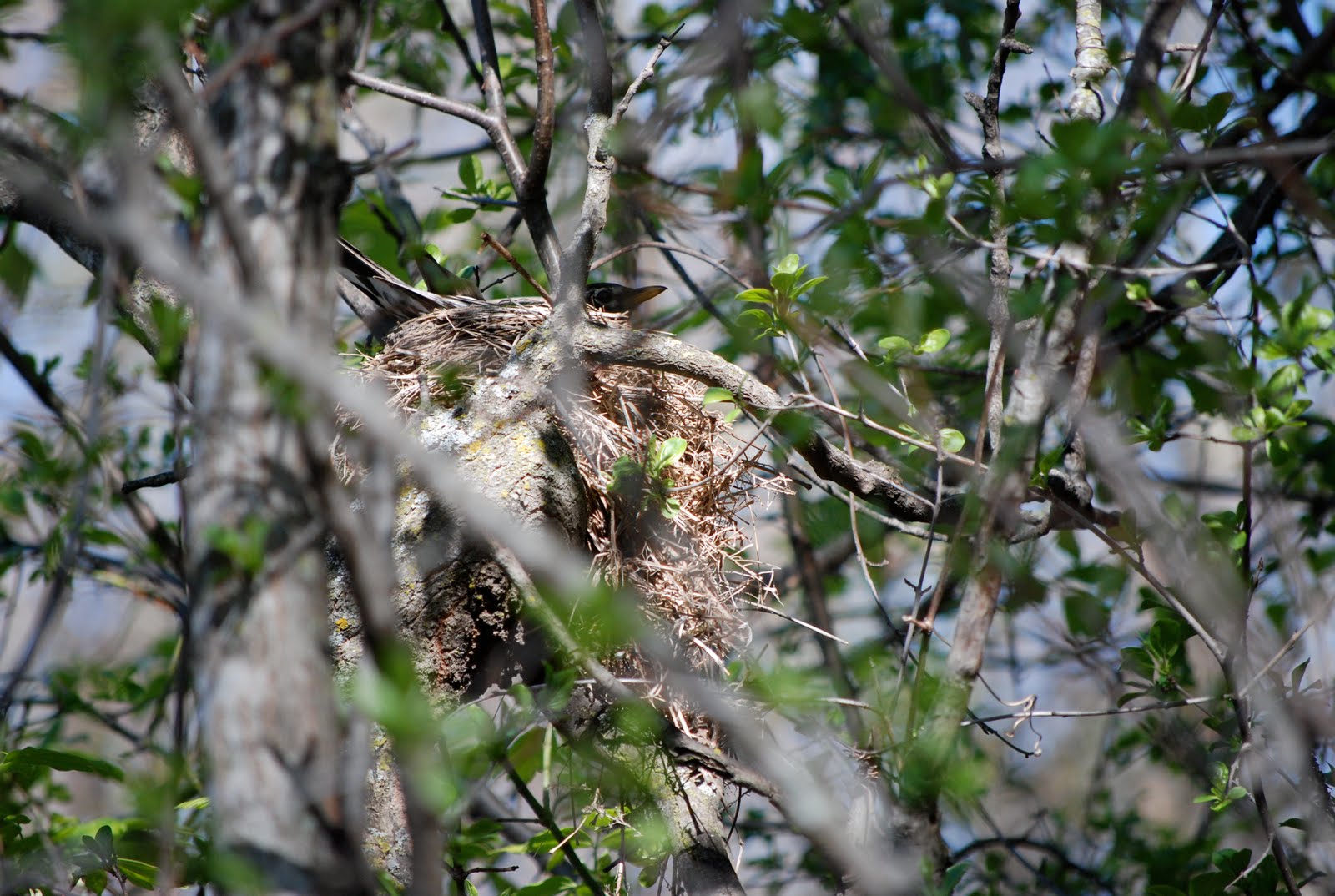
As I set up my banding table I had an American Robin just giving me the business for no apparent reason until Amber and I were sitting quietly and saw a female sneak onto a nest that was almost right above us. We would have never seen her if she hadn't moved. Can you see her in the photo above?


I've enlarged part of the photo to give a better look. This nest is right along a walking path but I'd bet money that if I took kids on a hike they would walk right past the bird and wouldn't have a clue what is right next to them. My goal is to teach the world to slow down and look up more often.

Saturday in the Park


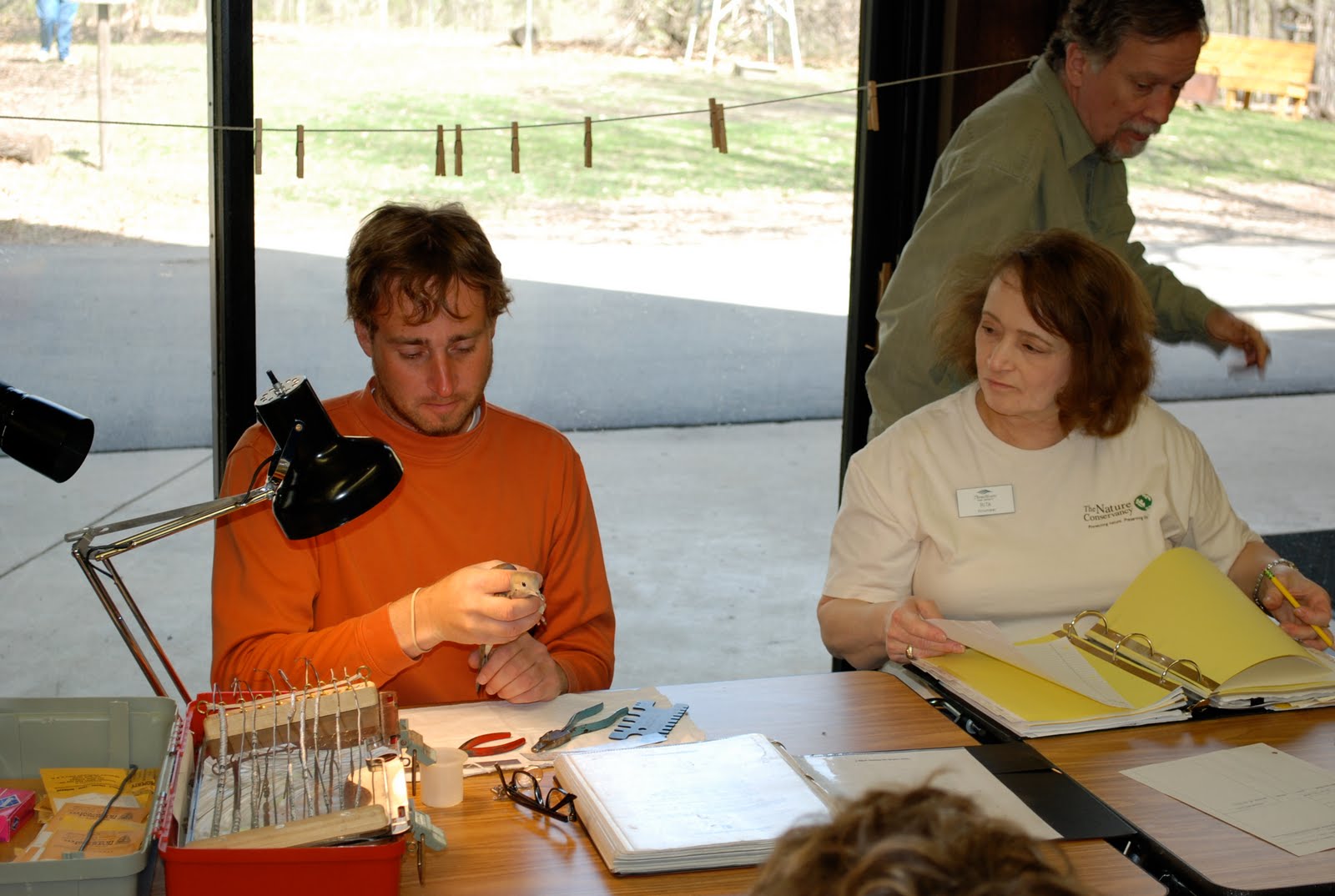
What a beautiful day to be out banding at Carver Park. The anticipation was palpable while I drove into the park as I could see all sorts of birds jumping up from the roadside and I could hear even more birds in the trees. I wasn't disappointed. As the crew got set up, the birds started coming into the station. Above you can see itinerant bird researcher Ben at the banding table processing one of the 20 birds we caught during our morning program. A complete list of birds caught will be listed at the end of this entry.


One of my favorite spring migrants is the White-throated Sparrow, Zonotrichia albicollis. This breeding plumaged male really made an impression on the visitors to our program.


Some of our regular residents also showed up such as this Downy Woodpecker, Picoides pubescens. The one skill banders are always improving is their ability to get birds out of mist nets efficiently and without harming the bird. It doesn't help when the bird you're removing is trying to drill a hole in your fingers.


This fellow was pretty cooperative and both bird and bander were none the worse for wear after processing.


We had a 3 woodpecker day including this Red-bellied Woodpecker, Melanerpes carolinus, which is quite a handful, especially when you're trying to get them to pose for pictures.


An unexpected catch was a female Mourning Dove, Zenaida macroura, a real "two hands" bird. Of all the birds we caught this one took the largest band (3A). Measuring a bird this size make all the other birds feel really small.

Totals for the day are below:

Ruby-crowned Kinglet (3)
Dark-eyed Junco (1)
Black-capped Chickadee (1 retrap)
White-throated Sparrow (2)
Downy Woodpecker (2)
Song Sparrow (1)
White-breasted Nuthatch (2 retrap)
Hairy Woodpecker (1)
Brown-headed Cowbird (1)
Red-winged Blackbird (4)
Red-bellied Woodpecker (1)
Mourning Dove (1)

Total Species = 12
Total Individuals = 20
Pretty typical numbers for a spring session.

Thursday, April 15, 2010

Bird Banding Program

With the warmer weather and the Nexrad radar pretty much lit up every night with migrants, I'm looking forward to this Saturday's bird banding program at the Lowry Nature Center in Carver Park, just west of Victoria, MN.

The program is free and open to the public. Hours for the program are 8am until noon. Stop out if you're in the area.

Tuesday, April 13, 2010

Birds Rock!

Here's a short video from the American Bird Conservancy that might appeal to the teenager in your life (or perhaps your own inner child).

Birds Rock

Monday, April 12, 2010

Early April Banding


Sunday afternoon was just too nice to pass up the chance to get out to the banding station and throw up some nets to see what was around. When I got to the site it was pretty quiet but I set 3 nets anyway and sat down to enjoy the warm temps and the scenery. I only had nets up for about 2 hours but I did get 2 of these nice Eastern Phoebes, Sayornis phoebe.


I was also able to net one of the smallest birds we handle all year, a Ruby-crowned Kinglet, Regulus calendula. This male sported a bright red patch of feathers on his head that isn't usually seen unless you get a good close-up look at the bird. Not an easy task with a bird that hardly sits still.

If the weather stays as warm as it is now I'm not sure how that will impact both migrating birds and those that will stay here to nest. It could be an interesting breeding season.

Sunday, April 4, 2010

Lots of Migration Movement in the South


The low pressure systems moving through the mid-west are setting up favorable conditions for birds to move in the south and southeastern regions of the U.S. tonight. Behind the front that sits across places like Chicago and St. Louis the movement is noticeably weaker.

We did band this morning and had several migrants in our nets that have showed up in just the past few days. Fox Sparrow, Ruby-crowned Kinglet and Song Sparrow are all over the place.

Reports from southern Wisconsin included Yellow rumped Warblers, shorebirds and swallows. Spring is starting to really take off.

Sunday, March 28, 2010

Movement in the Dakotas


I was checking the radar tonight to see if there was any movement ahead of the predicted warm up for the upper midwest this week and it doesn't look like much except in the Dakotas. It looks like there might be some significant movement tonight.

There are two big weather systems on either coast with the east coast really being affected. The next 2-3 days shoud be interesting as a high pressure system settles over the plains and brings highs in the 70's to the upper Mississippi River Valley by mid-week.


The other interesting spot is off the north coast of Cuba. It looks like a movement of migrants is making the jump from Cuba to the Florida peninsula and is being picked up by radar in Key West. There are storms over Florida so the migrants should make landfall shortly after reaching the southern tip of the mainland state.

Both of these images are from NOAA.

Thursday, March 25, 2010

New Field Guide to the Birds of Europe


Princeton University Press has released a second edition of it's birds of Europe Field Guide. I haven't seen it personally but the few comments I've seen have been positive.

Following is the text from the Princeton website:

"Since it was first published a decade ago, Birds of Europe has become the definitive field guide to the diverse birdlife found in Europe. Now this superb guide has been brought fully up to date with revised text and maps along with added illustrations. Uniquely designed for easy use in the field, this expanded edition covers all 772 species found in the region as well as 32 introduced species or variants and 118 very rare visitors. Detailed species accounts describe key identification features, voice, habitat, range, and size. More than 3,500 full-color illustrations depict every species and all major plumage variations, and color distribution maps provide breeding, wintering, and migration ranges for every species.

Complete with an introduction to each group of birds that addresses major problems of observation and identification, this new edition is the ultimate field guide to Europe's fascinating birdlife.

Expanded and fully updated
Covers all 772 species found in Europe, 32 introduced species or variants, and 118 very rare visitors
Features more than 3,500 color illustrations that depict every species
Includes detailed species accounts
Provides color distribution maps for every species
Color plates face text and maps for at-a-glance identification

Lars Svensson is one of Europe's foremost field ornithologists. Dan Zetterström and Killian Mullarney are two of Europe's leading bird artists."

Sunday, March 21, 2010

A "Sweet" Banding Session


In spite of the fact that the previous week had been really nice, Saturday morning started sunny but cold. With enough volunteers present we decided to go ahead and use mist nets along with our Potter traps in order to catch as many birds as we could during our program. We had some nice birds like the above Downy Woodpecker.


We still have a number of Dark-eyed Juncos and American Tree Sparrows around and we were able to catch some of both. This handsome fellow should be headed back north soon. If the winds change this week he may be in Canada before next weekend.


Something you don't get to see unless you have a junco in the hand is the variation of the amount of white on the third rectrix. This seems to be one clue to help aging juncos. The more white on R4 the older the bird (R4 on the right is the feather on the outside). As always though, you have to use the entire set of characteristics to really come to a good conclusion.


One of the hazards of living in cold climates is that sometimes the cold can do some damage. A couple of the toes on this junco appear to have been damaged by frostbite this winter. How bad the damage is, is hard to say. The discoloration though is obvious.


While we were banding, the nature center was also doing a program on making maple syrup and was boiling down some sap right where we were releasing our banded birds.


The odor was great and made this a really sweet session. We didn't get any early migrants but we did see 2 Red-winged Blackbirds at the feeders that were banded so we know some of "our" birds are back.

Numbers for the day are:

Black-capped Chickadees - 7 (2 being recaptures)
American Tree Sparrows - 15
Dark-eyed Juncos - 7
Downy Woodpecker - 2 (1 recapture)
White-breasted Nuthatch - 5
Hairy Woodpecker - 1 (a recaptured female)

Total species = 6
Total individuals = 37

Wednesday, March 17, 2010

One More Photo


Any time a question comes up about the identification of an odd bird, the wealth of knowledge and insight that weighs in on the subject amazes me. There seems to be some doubt as to whether the bird in question is truly a hybrid and if it is, what the parent besides junco might be. The photo above gives a view of the back of the bird that may help further the mystery. The streaking on the back certainly looks sparrowish. I don't know if this changes anything but it is another piece to the puzzle. If you double click on any of the photos you should be able to view it enlarged which should help show detail.

I'm looking forward to our monthly banding session this Saturday and if the weather holds it could bring in some early migrants. I'll post results later.

Monday, March 15, 2010

Hybrid Junco/White-throated Sparrow?


A friend of mine, Ben Sandstrom, is down in Texas doing some bird survey work this winter and has sent me some pictures of a Junco that suggest it is a possible hybrid with a White-throated Sparrow. The pictures here show the bird from different angles and hopefully are enough to reveal possible explanations.


One of the things I've learned and appreciate is that there are a lot of people out there who know way more than I do and are willing to pass that knowledge along. Well, this is one of those times. Is this a hybrid?


Ben did do a bit of investigating and found references to SCJU/WTSP hybrids but it seems all those records are from the eastern U.S.


The whitish throat and white stripe over the eye are seen the best in this photo. If nothing else, this will keep us busy while we wait on those migrants to move in to our neck of the woods.

Tufted Titmouse / Chickadee Hybrid

I've followed the discussion on line of the hybrid Tufted Titmouse and Black capped Chickadee and people who know a whole lot more than I do have pointed out some details that appear to confirm this birds hybrid status.

The best visible clue is the sharp demarcation of white on the face with a darker cap above. Tufted Titmice would be expected to have the color all the way down across the cheek. There were some other comments on some more subtle markings but it looks like this is the real deal.

Here are some other comments:
Mark Stackhouse said:
"The dark area on the chin was one of the things that I was hoping to get some input from the observer - I'm having a hard time deciding if those are actually black feathers on the chin, or dark gray (something that may be within the normal variation). The definition and shape of the line between the cap and the cheek do suggest a chickadee."

Allen Chartier said:
"I too was wondering about the chin, but as a bander I see a lot of bird with white underparts that show dark bases to the feathers, and the absence of some throat feathers could create this effect. Or, staining from sap..."

Tony Leukering said:
"I didn't have any problem with Matt's ID on this bird, it seems an obvious hybrid to me, with only some of those reasons already pointed out in this venue. I'd add two more:

1) The placemenht of the eye relative to the dark of the crown is intermediate between the two species -- TUTI has the eye entirely surrounded by pale, while BCCH has more of the eye within the black of the crown;

2) The nasal tufts are brown, something that is variable in BCCH (brown or black) and, as far as I'm aware, invariant in TUTI (black)."


So with that pretty much put to bed the next post is going to be another hybrid puzzle. Stay tuned!

Saturday, March 13, 2010

Is This Really a Hybrid?


I've copied a picture taken by Matt Farker of Bloomington, Illinois of a reported hybrid Black-capped Chickadee x Tufted Titmouse. Tom found this bird and has reported it to the Bird ID listserve as a rare hybrid.

To be honest, I'm having trouble seeing the characteristics that convince me of it's status as a hybrid. Admittedly I haven't looked in any references yet but I wouldn't have picked this bird out as unusual. Tufted Titmouse is not found commonly where I live but I do catch them once in a while when I'm in Wisconsin banding birds.

Here is a link to the original photos.

Any thoughts???

Monday, March 8, 2010

More Signs of Spring


After I posted the radar map showing what I think was an early migratory movement, I received a couple of comments that support that birds are starting to move in the south.

Mitch from near San Antonio, Texas said:

"We have had recently White-fronted Goose flocks
heading north at night. Cranes have been moving too,
but that is generally diurnally."

Catherine in Wichita, Kansas wrote:

"I just saw a Gray Catbird in Wichita, Kansas this morning. I
believe it's very early for that species to be here. Typical dates are
early May to late September, according to Thompson & Ely 'Birds in
Kansas, Vol. II.'"

I'm really starting to feel the onset of spring fever. I'm hearing reports from Wisconsin that Sandhill Cranes are showing up as are a few Killdeer here and there. The Mississippi River is opening up and Bald Eagles are beginning to head north. Horned Larks appear to be along the shoulder of many back roads around here and every morning the singing seems to get louder and louder.

On the other hand, I know that we haven't seen the last snow of the season yet and my son will still have to watch out for icy spots on the road as he bikes to school in the morning. However hope springs eternal and I know that before long I'll be sitting out in the woods, swatting mosquitoes and cursing the hot, humid summer days.

Wednesday, March 3, 2010

Radar Indication of Migration in the southern Great Plains

Thanks to the folks at University Corporation for Atmospheric Research (NCAP) I think we're starting to see some migration movement already in the states of Texas, Oklahoma, Kansas and Nebraska.


This is the second night in a row that this return pattern has shown up in the same place. It could be waterfowl or something else. The color of the return seems to indicate that the numbers of birds moving might not be large. I saw the same image last night but hesitated to post because I've just never looked for migration this early in the spring but from posts on line it does sound like things are beginning to move around.

If you got to the National Weather Service and click on the button for a looping view of the national map, you can see the rings in the lower plains enlarging over time.

This is really going to help make my case of spring fever even worse!

Saturday, February 20, 2010

Visitors From the North

If all of winter could be like today, I think there would be less complaining and more playing outside. We had a great day to hold our February banding session at the Lowry Nature Center and we had quite a number of visitors who came out to watch.


We only handled 3 species today but one is especially nice to work with. This American Tree Sparrow, Spizella arborea, was one of the species we hadn't caught a lot of recently. American Tree Sparrows are the birds that were the basis of the banding program at Lowry some 40 years ago.


What I like is the ability to see birds from a different perspective and I think the back of this bird is just beautiful.

It won't be very long before the birds that are wintering here will begin to make their journey back north to the edge of the tundra in Canada.


The only other species we handled today were White-breasted Nuthatches, Sitta canadensis, and Black-capped Chickadees, Poecile atricapilla. The photo above is a nice illustration of the difference between the color of the cap on a male nuthatch (glossy black) and the color of the cap on a female nuthatch (grayish, sometimes with flecks of black).


As far as totals go, today we handled 36 birds, 27 new and 9 retraps. Below is the breakdown:

Black-capped Chickadee 16 new and 7 retraps
American Tree Sparrows 8 new and 0 retraps
White-breasted Nuthatch 3 new and 2 retraps

Our next banding session will be March 20, 2010.

Wednesday, February 17, 2010

Banding Program on Saturday

For anyone interested, we will hold the regular monthly banding session at Carver Park near Victoria, MN.

Details:

Bird Banding Program
Lowry Nature Center
Saturday Feb. 20, 2010
9:00 am - noon
FREE


Directions here.

Monday, February 15, 2010

Banding Totals

I've finally got some time to sit down and do a bit of data crunching with my banding numbers and I am quite proud of how things have gone since I got my subpermit in 2003 (thank-you Mark!)

As of the end of 2009, I have banded 1060 individuals of 65 species. Of course this doesn't include all the birds I've handled on other peoples projects so the numbers would be even higher if I included them.

For 2009 I have banded the following:

American Goldfinch (AMGO) 14
American Redstart (AMRE) 3
American Robin (AMRO) 4
Black and White Warbler (BAWW) 1
Black-capped Chickadee (BCCH) 42
Brown-headed Cowbird (BHCO) 1
Blue-headed Vireo (BHVI) 1
Blue Jay (BLJA) 3
Brown Thrasher (BRTH) 2
Canada WArbler (CAWA) 1
Cedar Waxwing (CEDW) 12
Downy Woodpecker (DOWO) 9
Eastern Bluebird (EABL) 8
Eastern Wood Pewee (EAWP) 1
Eastern Tufted Titmouse (ETTI) 3
Fox Sparrow (FOSP) 5
Golden-crowned Kinglet (GCKI) 2
Gray Catbird (GRCA) 2
House Wren (HOWR) 2
Indigo Bunting (INBU) 1
Least Flycatcher (LEFL) 4
Yellow-rumped (Myrtle) Warbler (MYWA) 13
Nashville Warbler (NAWA) 3
Northern Cardinal (NOCA) 8
Orange-crowned Warbler (OCWA) 2
Ovenbird (OVEN) 3
Purple Martin (PUMA) 163
Ruby-crowned Kinglet (RCKI) 4
Red-eyed Vireo (REVI) 3
Red-winged Blackbird (RWBL) 1
Dark-eyed Junco (SCJU) 21
Song Sparrow (SOSP) 4
Swainson's Thrush (SWTH) 2
Tennessee Warbler (TEWA) 4
Trail's Flycatcher (TRFL) 1
Whiye-breasted Nuthatch (WBNU) 7
Western Palm Warbler (WPWA) 1
White-throated Sparrow (WTSP) 11
Yellow-bellied Flycatcher (YBFL) 1

That's a total of 39 species and 373 individuals. I'd say it was a pretty good year. The goal for 2010...400+ birds!

Wednesday, January 6, 2010

Back for the start of the new year

I haven't been very good about keeping up with this blog because of the holidays and all but I think I should be able to be more efficient from now on. Not lots has been happening banding wise but a couple of things have been interesting lately.

I got a note from Illinois that a Fork-tailed Flycatcher was being seen in East Moline about the same time the same species was being seen in Finlayson, MN. I hope to post some pictures later of the Illinois bird.

We have also been tracking Golden Eagle #42 as it has come back to western Wisconsin after spending the winter in northern Canada. It's been hanging out and feeding on deer carcasses near our Wisconsin banding site.

Finally, I will be totaling up last years banding numbers and will post that soon also. It was probably my best year as far as numbers but if it hadn't been for all those young Purple Martins I banded my numbers wouldn't be as high. I did notice a definite lack of warblers banded this year.

Saturday, November 28, 2009

Update on Fork-tailed Flycatcher

Well the pictures of the flycatcher really caused a buzz for a day or so. I feel bad that I didn't have more details about location. I did hear that the bird had been seen at this location in Pine County, MN from Nov. 18th to the 25th. I don't know if anyone besides the person who took the photos got to see it. I believe this is only the 3rd state record for this species. A couple of people in the Minnesota Ornithologists Union were contacted and I believe the bird will be documented so it can be accepted as "official". I'll see what folks say at next weeks MOU meeting.

Thanks to all who responded to the post. Not a bad end to the fall season!

Wednesday, November 25, 2009

Fork-tailed Flycatcher in Minnesota???


A friend of mine has passed along a couple of pictures that he received recently that appears to show a Fork-tailed Flycatcher in
Finlayson, Pine County, Minnesota. I don't have permission to give directions to the bird or even know if it's still around. Pretty cool though.


Not as good a look but pretty convincing to me.