Tuesday, February 19, 2013

Winter Birds Part 1

Exploring the Sax-Zim Bog on Saturday was really a treat. This is an annual excursion with a couple of good friends and even though the temps were low the sun was out and there wasn't much wind. We're lucky here in Minnesota in that we don't have to go very far to see some great birds. All the better if the birds come south and meet us half way. For example, there is word of a big number of Great Gray Owls in Roseau County (almost 60 in one part of the county).
 The most common bird of the day were all the Common Redpolls, especially at the feeder stations. I'm sure that there was the possibility of Hoary Redpolls being present but I just didn't get a good enough look to make the call.
There has been a pretty good movement of redpolls into the southern part of the state and I have had both redpolls and Pine Siskins at my feeders at home most of the winter.
 Along Blue Spruce Road there is a feeder station that is famous with birders. This is the spot to see several northern specialties all in one place. The Pine Grosbeaks were around but were a bit jumpy. In spite of that we had good looks.

We did see a couple of Evening Grosbeaks at this same feeder but their numbers are a bit lower than we've seen in the past. Most of the individuals we saw were either females or juveniles.
This is the best shot of an Evening Grosbeak that I got. Way back in the day, this used to be one of the most common species at feeders during the winter. Now it takes a lot of work to see any.

Tomorrow, more from the bog.

Sunday, February 17, 2013

Bog Boreal

I had a great day at the  Sax-Zim Bog yesterday and have lots to write about in the coming days but I wanted to share this sighting with folks. We spent many hours driving the bog and were really working hard to even see the local birds. The temperature when we arrived in the morning as -12 degrees F but fortunately there wasn't much wind. Needless to say the early morning wasn't as productive as usual.

On our third trip down Admiral Rd. (a place anyone who has visited the bog will be familiar with) we saw a group of cars on the side of the road with tripods and cameras out. At first we thought this was the feeder station but it was actually north of the feeders. We pulled up and were ecstatic to see a very cooperative Boreal Owl sitting on a branch on the side of the road. It had been there at least 2 hours and wasn't going anywhere soon so I and my two birding buddies Bill and Russ all got a lifer at the same time and filled up a good portion of our cameras memory card with photos of this bird.

This wasn't the only surprise of the day but that story will have to wait until tomorrow.

Friday, February 15, 2013

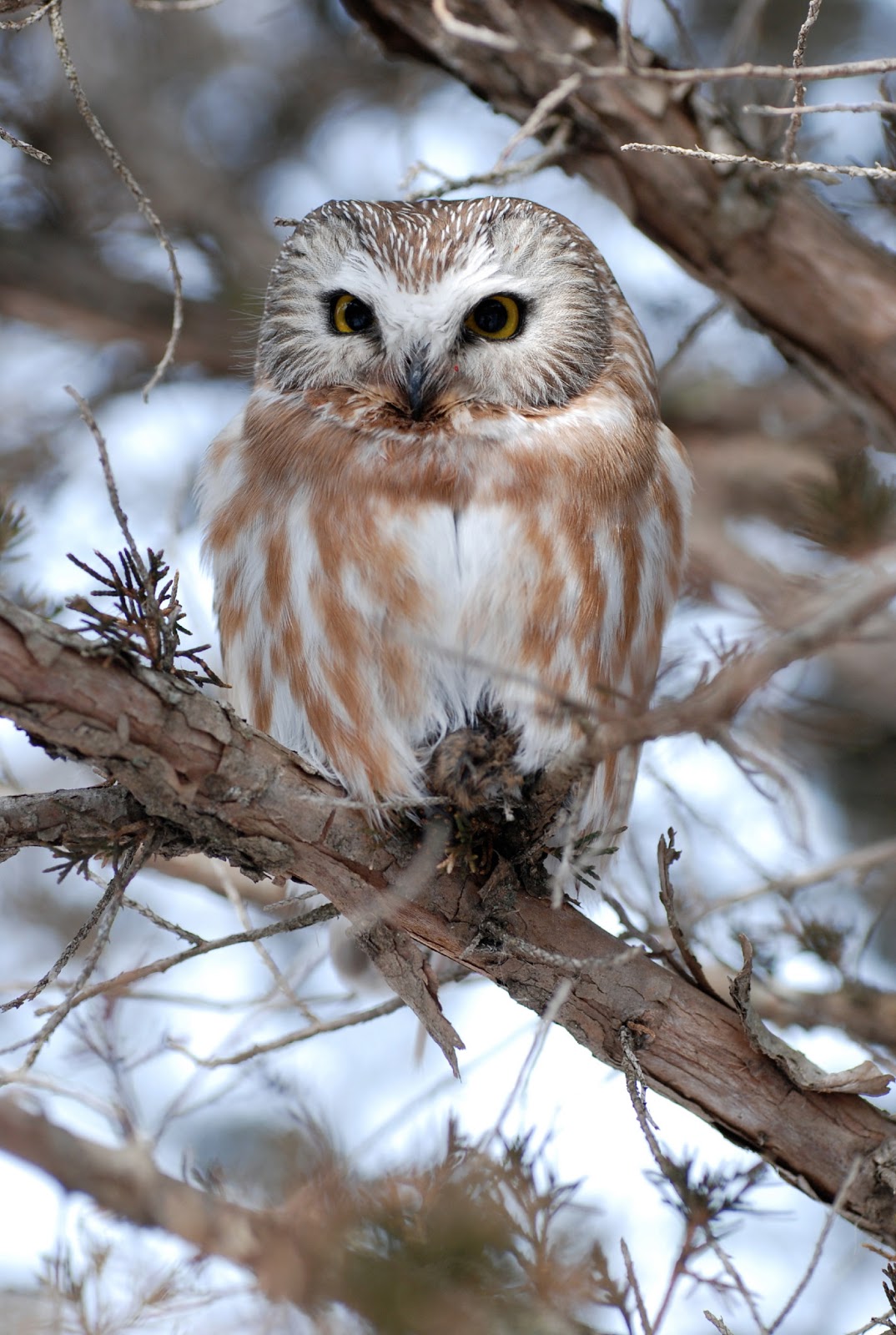
Searching for Saw-whet Owls

One of the hardest groups of birds for birders to find sometimes are owls. It can be easy to hear them at certain times of the year and if you know where a breeding pair are you often get a good look. However if you know where to look and what to look for when you're out in the woods you can improve your chances of finding owls that might otherwise go undetected. Most often though seeing owls is a matter of being in the right place at the right time.

When I'm out in the winter time here in east central Minnesota, if I want to know if there are any owls lurking in the area I'm visiting, I'll look for telltale signs of an owl roost. For the elusive little Saw-whet Owl I'll check the Eastern Red Cedars along the trails I'm hiking. Every once in a while I'll find some "whitewash" on a tree trunk. This is a sign that someone is spending significant time in that spot.
Once you see what might be a roosting branch the next thing to check is the ground below the tree. Owls, of course, swallow their prey whole and cannot digest everything they take in so they regurgitate the undigested material as a "pellet". You can even see a pellet on the ground next to the tree trunk. If an owl is spending time in the same spot these pellets tend to accumulate. A careful check can produce a handful of surprises.
These Saw-whet pellets are quite large for a bird that is so small but that appears to be normal. If you want to investigate the owls diet it is easy to tease apart the pellets and look for bits of bone and skull. This bird was eating lots of rodents.

A little patience and some careful skulking can reward a birder with a close up view of a bird that many people have never even heard of. If you do find a roosting owl, please keep a reasonable distance and try not to disturb the bird since any extra expenditure of energy can be a detriment to the wintering owl. But if you do get a look it will be well worth the effort!
Here's to good birding!


Thursday, September 27, 2012

A New Tool for Banders

The Bird Banding Lab recently sent out a note to banders describing a new website that looks like it might be useful to banders when it comes to having photos of birds in the hand that will help age and sex different species. The site is called Piranga and it is found through NatureInstruct. Not only is it a source to use, it is also a site to which banders can contribute.

When trying to determine age and sex of birds it is often necessary to look at every feather of the wing and/or tail along with other characteristics depending on the species.
 This Blue headed Vireo is an example of a bird that was aged by looking at the wing feathers. We took a documenting photo of the wing to show what we saw and why we aged it as we did. The photo of the wing is the type that is found on Piranga.
If you look at the greater coverts (the feathers that form the lower wing bar) you'll see the one on the very left is different. This feather is retained and has not been molted yet. This molt limit is definitive for age. This bird was caught in September and was aged hatch year. I think this could be a great resource for figuring out tough species or even for reviewing the characteristics of species that we know we will be banding before they arrive in numbers. I know that I am going to spend time looking at both fall Yellow-rumped Warblers and Slate-colored Juncos. They can be confusing at certain times of the year.

Registration is free and as a disclaimer I am not associated with the site at all (but wish I was).

Tuesday, September 25, 2012

Hello Again!

It has been quite a while since I have written a post. The lapse started last spring with a bout of pneumonia and continued through the summer with a big garden, high school bowling tournaments for my kids and a terribly hot and dry banding area. I skipped a lot of banding due to the weather but this fall has started to be a bit more reasonable as far as banding goes.
The North Central Bird Observatory (me and Mark Newstrom) held 3 fall banding sessions at Ritter Farm Park near Lakeville, MN and the last of the 3 was really good for banding migrants. This Black and White Warbler was just one of several species we banded.
 This young Connecticut Warbler was a surprise find in the nets. It was caught in that typical place for this species, the very bottom of the net. It was skulking along the edge of a small wetland where we have one of our net lanes. This is only the second COWA that I have handled so it was pretty exciting.
Always nice to catch are Ovenbirds. For me, this is a true sign of banding in September. Some days Ovenbirds are the most numerous species in the nets.
This Brown Thrasher was a real hand full (literally) and was a big hit with the visitors to the banding program. Unfortunately we see fewer of these than we used to.
The "best catch" of the day might be a tie between the Connecticut Warbler and this Philadelphia Vireo. We have had a few of these in the last couple of years and to be honest I see more in the nets than I see through my binoculars. Another sign of fall banding.

Here's hoping October is a productive month for our nets and maybe someone will catch these birds on their wintering grounds. Hear that Manuel?!

As an aside, I have started "tweeting" and hope to post more timely bird updates. Follow me under user name RDEverhart.

Thursday, May 10, 2012

A Typical Spring Banding Session

The second session of bird banding at Ritter Farm Park near Lakeville, Minnesota was a classic spring session. The worry was for the day to be cold and rainy but we got lucky and the rain that threatened passed through the area overnight and by the time we set our nets, the area was beginning to dry out nicely.
The trees were just alive with migrants that appeared to have just arrived that morning. While banding we would run over and check out the nearby oaks and tick off a couple of new species. Then we'd run the nets and pull 5 - 6 more birds to band and so on and so on.
Some of the birds we caught do breed in the park but I have a feeling that this wave contained a lot of birds that would continue north. We also saw lots of FOY (first of year) birds, mostly warblers. The Rose-breasted Grosbeaks (above) just showed up in the last week.
Many of our catches only show up for a couple of weeks in spring and fall. The Nashville Warblers are here with Tennessee Warblers and we still have numbers of Yellow-rumped Warblers around but we also saw Northern Parula, Chestnut-sided and Cape May Warblers. Wish we would have netted some of them!
Interestingly and for the first time in our memory, the most common bird we banded that morning was the Northern Waterthrush. We had 6 for the day and they seemed to be everywhere. Sometimes the best catch of the day is a single individual and that was the case today. We only netted one Swamp Sparrow but it was banded and it was our band. Checking our records we found that we had banded this bird in just about the exact same spot back in 2007. It was an ASY bird then which makes the bird at least 7 years old. This is very close to the age of the oldest Swamp Sparrow documented in the Bird Banding Labs longevity records. We catch it next year and we're in the record book!

We're up north this weekend trying to see if we can add big numbers for the spring at West Twin Lake. Sounds like the weather should cooperate. I'll post results when I get back. Until then, get out in the woods.

Saturday, May 5, 2012

Quick Note

Lots of new bird species showing up in my area every day. We are holding the second spring banding session at Ritter Farm Park in Lakeville, MN tomorrow if the weather cooperates which is questionable. Should be some neat captures if we can set nets!

Sunday, April 29, 2012

Slow Morning

We had our first banding session of the spring at Ritter Farm Park near my house today and spent a lot of time staring at each other and telling stories. Pretty slow day. Heard lots of stuff but the wind was a hindrance. Not much flitting through the underbrush.
The first bird of the day was an Orange-crowned Warbler but I didn't take any pictures of it. This was our second, and last, bird of the day - a nice Swamp Sparrow. We have been hearing them around for a couple of weeks now.
I love the colors in our native sparrows. Too many people think sparrows are all dull and brown and boring. It's fun to see the look on their faces when you can show them a sparrow up close and they really see it for the first time.
 Along the road out of the park we had a chance to stop and check out the local Bald Eagle nest. One adult is standing guard but I haven't seen any fuzzy heads sticking up from the nest yet. This site has been pretty productive over the last several years so I hope to see some youngsters soon.

We have another session next Sunday and with the predicted change in weather we hope that day will be more productive.

Sunday, April 22, 2012

Shorebird Season

I had a chance on Friday to get out to the local refuge and chase a White-faced Ibis that showed up for all to see. It's not as good as the Eleania that showed up in Chicago but I'll take what I can get. I got a good look at the Ibis but it wasn't close enough to get any good photos so after a while I started to notice some shorebirds close to the observation deck I was on. The conditions were perfect and I took advantage to get some nice shots.
For a couple of weeks we've had both Greater and Lesser Yellowlegs (above) hanging around. The only other type of shorebird in the area are Pectorals but none were around. The birds didn't seem to be too concerned about all the people on the deck and came quite close.
It was a good opportunity to get side by side views of the Greater and Lesser Yellowlegs and I think I have a much better handle on how to tell them apart now. This Greater Yellowlegs is in full breeding plumage which is why he appears so dark.
Also around but not quite as cooperative were a few Wilson's Snipe. They mostly stayed just inside the edge of the cattails but once in a while they would venture a bit farther out into the open.

The majority of shorebirds are still to the south but little by little they will be arriving in my area. Today I saw my first Dunlins and expect the pace of arrivals to pick up. Now if we can just make sure the mudflats are around I should have a fun time trying to ID all the peeps that are on the way.

Tuesday, April 17, 2012

Close Encounter with a Window

All birders know that one of the big dangers to birds is the common, everyday window. Big windows near good habitat can be really bad for bird strikes so I wasn't surprised to find a stunned Yellow-bellied Sapsucker laying in front of one of the windows at my school yesterday morning. It didn't look good but I picked the beautiful male up from the ground, found a cardboard box in my office and put the little fellow into a quiet spot for a couple of hours.

Lo and behold I checked on him to find a bird that was alert and ready to go. Sometimes things do work out the way you hope they will. Just before release I had a student grab his camera and take a few shots for the old scrapbook.
Once we had a couple of pictures I let him go and he flew up and into a pretty brisk wind. Last I saw him he was headed north.
Yellow-bellied Sapsuckers are more common in this area than most people know. In fact, when I showed the bird to some of my students they had never heard of the species. A few giggled at the name sapsucker (teenagers!).
I know that there is a chance this bird still might not survive the window strike. Sometimes birds will appear to recover but over the next day or two they can succumb to bleeding from small fractures in their skull. In spite of that I have every confidence that I might have a chance to see this guy again. My only regret is I didn't have my banding box otherwise this guy would have gotten some new jewelry before I set him free.

Monday, April 16, 2012

Wind Riders

     Those strong winds out of the south on Saturday night had me chasing all over the area on Sunday trying to see some unusual visitors that were found pretty close to where I live. I saw the state listserve messages in the morning and immediately got in the car to chase a Black-necked Stilt that my friend Sue P. had found in the Minnesota River Valley. It's always easy to know where a rare bird is by just looking for the crowd of people looking through spotting scopes, pointing and talking in low tones. I ticked that one off in about 20 minutes after it decided to come out from behind a tall line of dead cattails.
     As cool as it was to watch it feed from a close distance I pulled myself away and headed down to Lake Byllesby to look for a group of 7 White-faced Ibis which were seen on the mudflats that I usually visit to look for shorebirds. Found Sue P. checking out some shorebirds but didn't see the ibis. Not sure where they went but I almost expect to see a report anytime. I did get to add Baird's Sandpiper to my year list but the winds were not cooperative. In fact, we got chased out as a strong storm front moved into the area.
     The conditions during the day were warm and humid, almost tropical. This morning it is 37 degrees and snow flurries. Go figure...

Sunday, April 15, 2012

Winds Blowing Birds North

A look at the wind map for the U.S. at 12:30 am shows strong flow out of the south. The weather radar also shows heavy movement of migrants south of the storm system moving out of the Great Plains and into the Great Lakes area. Below is the wind map for tonight:
The radar looks like this from the gulf to southern Iowa:

 From Texas to Iowa the winds are very favorable for birds to move. Unfortunately the storms moving into the upper midwest will cause the birds to stop short of coming into Minnesota. I was encouraged today by some new species that have showed up in the last week or so. I saw my FOY (first of year) Field Sparrow, Chipping Sparrow, Yellow-bellied Sapsucker and I could swear I heard an Eastern Wood Peewee but it only called once and I never saw it so on the outside chance that it was a Starling  trying to make me crazy I can't say for sure it actually was a Peewee.

Birders in the south should have a great Sunday of birding.

Wednesday, April 11, 2012

Texas Active This Morning

A look at radar this morning shows a pretty good movement of birds into Texas but no where else. The image below shows Texas just around sunrise.
As the sun gets higher, the birds begin to land for the day. Notice the line of weather in the upper right hand corner of this image. That is a cold front moving down from the north. There was no appreciable movement anywhere behind this front so I don't think much will change as far as migrants in the midwest.
Some of the strong southerly winds we experienced in the last couple of weeks brought the surprise of a Brown Pelican to Minnesota. This is only the 3rd state record for this species and it hung out around the city of Red Wing on the Mississippi River for about a week. The last sightings of the bird (assuming we only had one Brown Pelican) were as it continued to move north and it was last observed just north of the Twin Cities.

As winds shift, the weather is forecast to bring a warming trend so all those birds in the south will hopefully show up in Minnesota by the weekend when I have a chance to get out.

Sunday, April 1, 2012

Quiet Weather Means Birds Moving

The weather finally has moved out of the midwest and into the northeast. This means relatively quiet conditions in the Mississippi Valley and the southeast. A look at the weather radar tonight shows lots of movement in the eastern half of the U.S..

Here are two images from tonight. The first is right around sundown here in the midwest -
Notice how the returns are already darker in the southeast where the sun has been down for a while.
This next image is from about an hour later, 9:10 pm CST. Note the heavier returns all across the region-
Note the weather front in the upper right hand corner of the image. On the front side of that line there is little if any movement showing up on radar. Folks in the northeast probably won't see as much movement as in the midwest tonight. Once that front moves through bird activity should increase, probably tomorrow.

I was out and about tonight and saw my first American White Pelicans of the year but in spite of lots of mudflats at a local reservoir I only saw a couple of shorebirds. Maybe we'll see some more this week.
Keep looking up!


Saturday, March 31, 2012

Down in Texas

I took a look at the national radar at about 11:00 pm and saw lots of movement in the southern tier of states but not much in the upper midwest. I did take a screen shot of the radar at Brownsville Texas and I believe we're starting to see migrants moving up from Mexico.
You'll notice lots of color around McAllen but nothing really out over the gulf. This is because birds tend not to fly over water unless they have too. The birds moving into Texas are following the coastline. A look at a broader radar picture shows movement all through Texas.

Not much happening in Minnesota right now so I'm waiting patiently for these birds to get here in a couple of weeks.

Wednesday, March 28, 2012

Shrike at 180th Street Marsh

Here's a short video of the a shrike that was hanging around at the 180th Street Marsh a little while ago. It was pretty windy so you might want to take a Dramamine before you watch this. ;-)

Monday, March 26, 2012

Migration in the south

With the migration this spring being so unusual, I wasn't surprised to see a pretty good indication of movement tonight in the states of Arkansas, Louisiana and Missouri. The two images below show the change in radar returns in the hour right after sundown.
 The image above shows the beginning of lift off at sundown. As time goes on the return images become larger and darker. The image below is from about 9 pm CST.
The heaviest movement looks to be in western Arkansas. The weather in Minnesota today was rainy and cold (compared to what it has been) with a high of 42 degrees. Tomorrows predicted high is near 70 degrees. That warm southern flow of air might just carry a whole new batch of migrants into the backyard. I'm hoping to check the radar in the morning to see if it shows any movement into my area. This could be the next wave of really early surprises!

Tuesday, March 20, 2012

Sunday at the Marsh

A quick entry to say that I spent Sunday afternoon in strong winds trying to get a look at what has shown up at the marsh on 180th Street in Dakota County, Minnesota and even though most of the birds were in the more protected area at the back of the marsh it was a pretty good day. Using the car as a windbreak and scanning with my scope I was able to see some nice migrating waterfowl. The list for the day is as follows:

Canada Goose
Gadwall
American Widgeon
Mallard
Northern Shoveler
Green-winged Teal
Canvasback (1)
Ring-necked Duck
Lesser Scaup
Bufflehead
Pied-billed Grebe
Bald Eagle (1)
American Coot
Killdeer
Loggerhead Shrike (1)
Horned Lark
American Robin
European Starling
Red-winged Blackbird 
Common Grackle

The next few days will see several weather systems move through the area which will bring some much needed rain but won't do much to cool down the temperature. Highs are still predicted to be in the 70s for the rest of the week. What a strange March it is.

Thursday, March 15, 2012

Bird Banding on Saturday

The weather continues to be unbelievable here in Minnesota and is making Saturday's banding session look more like a day in May than March. We may see migrants in our nets that we wouldn't expect until next month. Last night I heard a flock of Tundra Swans flying over my house at about 11:15 pm. They were so loud I could hear them even with all the windows closed.

If anyone is around on Saturday we are holding our monthly bird banding session at the Lowry Nature Center in Carver Park Reserve from 9-noon. We would love to have folks come out and see some birds up close. Don't worry, the rain should hold off until we're done. For directions to the park please check the Three Rivers Park District website.

Get outside and look up.

Sunday, March 11, 2012

A Sunday Afternoon Walk

 
It's March 11th and it feels more like April 11th. This is the month we should be getting our spring blizzards and hoping to survive until warm weather but instead we're going to have temps in the 70s this week. Lots of birds are moving in significantly ahead of schedule. The lakes usually look like the picture above but most are very close to opening. I wouldn't be surprised to see many lakes ice free by Friday. 

Yesterday I headed down to the southern part of the county to Lake Byllesby Regional Park and saw thousands of geese milling around on the lake. The group was made of of 3 species, Canada, Greater White-fronted and Snow. Lots of Pintails and Green-winged Teal too.

I decided to get out and enjoy this afternoon down at the Old Cedar Bridge area of the Minnesota River Valley National Wildlife Refuge. One of the first signs of spring was singing Redwing Blackbirds all over the place. Song Sparrows flitted through the grasses along the edge of the trail and every open bit of water was full of waterfowl. The complete list of species for the day is as follows:

Greater White-fronted Goose
Canada Goose
Trumpeter Swan
Wood Duck
Gadwall
American Widgeon
Mallard
Northern Shoveler
Northern Pintail
Green-winged Teal
Ring-necked Duck
Lesser Scaup
Bufflehead
Common Goldeneye
Hooded Merganser
Common Merganser
Bald Eagle
Northern Harrier
Red-tailed Hawk
American Coot
Killdeer
Ring-billed Gull
Hairy Woodpecker
American Crow
Black-capped Chickadee
White-breasted Nuthatch
American Robin
Song Sparrow
Northern Cardinal
Red-winged Blackbird

I can only imagine that many more migrants will show up this week with the warm temps and the strong winds from the south. Get out and look up!

Saturday, March 3, 2012

Golden-crowned Kinglet

The weather in this part of the country has been, to put it mildly, strange. First it's warm and then it's cold and then it rains and then it freezes and then it snows before deciding to get warm again! March has always been a tough month to live in Minnesota. It makes April seem like a luxury. So to make a long story short, I haven't been out birding beyond staring at the feeders in my backyard. That doesn't mean I don't have a little something to post...
Some of the littlest birds that we see here in Minnesota are the Kinglets. Ruby-crowned are, by far, the more common of the two species around. They'll be here in October on the way south and then we'll see them again in April as they head back north. Once in a while we'll see the guy pictured above - a Golden-crowned Kinglet. We have a spot we check every December during the Christmas Bird Count because it is not unusual to find a few overwintering in the pine groves. An even better day is when we find one or two of these birds in our nets while we're banding.
In the hand we get to see characteristics that might otherwise go unnoticed. To determine the sex of the bird we part the crown feathers and look for orange-red feathers along with the yellow ones. As you can tell, this bird had a nice crown full of both yellow and orange feathers making this a male. Females will only show yellow feathers in their crown.

Seeing this in the field is more difficult, so telling a male from a female at a distance is usually not possible. We should start seeing this species later this month as they head to their breeding grounds up in the spruce forests. Keeps your eyes peeled and your ears open. The next 3 months should be fun!

Saturday, February 25, 2012

Fun at the Feeders

When the days get busy around the house (and with three teenagers when isn't it busy?) I appreciate the fact that I can still look out my windows and enjoy some of the visitors to my yard. Even though I can't remember a time when bird feed was more expensive, I still consider it a bargin when compared to what I get out of seeing some of the local residents.


This Common Redpoll was one of two individuals that showed up at my feeders on New Year's Day and I haven't seen any since. I was lucky enough to see lots of these birds when I was up in northern Minnesota last month but around here this is a great bird for the yard list. The birding gods must have been smiling down on me in order to start my year list with this bird.

The Red-bellied Woodpecker is a year round visitor to my yard. I can count 7 species of woodpecker that have come to my yard/feeders but by far this bird along with Downy and Hairy Woodpeckers are the bulk of my visits. I did hear and then see a Pileated Woodpecker today as he was making his rounds of the neighborhood. They look absolutely prehistoric in flight. I'm hearing lots more spring songs as the day lengthen.

Here we have the classic White-breasted Nuthatch pose, head down. It won't be long before this female is hunkered down in a cavity, sitting on a clutch of eggs. By then the migrants will be making their biennial trip across the landscape. I expect the radars down south to start showing migration pretty soon. Our first red-winged Blackbirds are due back in a couple of weeks. With the way this winter has been I wouldn't be surprised to see birds arriving ahead of their usual dates. On the other hand, I'm not putting the snow shovels away just yet.

Wednesday, February 22, 2012

More Sax-Zim Photos

      Looking through the photos I took up at the bog in January I found 3 more to post for people to see. The first shows both species of chickadees that are found at the bog. Just click on the photo for a better view.
    One of the real treats to visiting northern Minnesota is the chance to see both Evening and Pine Grosbeaks close up. When I was a college student in northern Wisconsin, Evening Grosbeaks were the most common birds at feeders in the winter. It wasn't until the populations of these birds began to decline that I understood just how lucky I had been to see them in the numbers I did.
    Finally, as birders know, some of the best sightings happen as you're traveling along and just happen to look in the right place at the right time. This Rough-legged Hawk was sitting off the side of the road as we were heading to another location and was found just by the fact that there were lots of eyes looking in lots of directions.
    Hope you enjoy the look at some northern birds!

Sunday, February 19, 2012

Late Winter Bird Banding

     It's only the middle of February but it feels more like the middle of March and the birding feels more like late winter rather than mid-winter. We have had such a strange season with very little snow and relatively mild temperatures that it is hard to know how this will affect the spring migration season. We here in Minnesota are suffering a really significant drought which bodes well for spring flooding but we could use some precipitation soon for soil moisture to be adequate for the growing season.
  

     Regardless of the weather we still are holding our regular banding sessions and on Saturday we banded for 4 hours at the Lowry Nature Center in Carver Park Reserve near Victoria, Minnesota. The totals were good for the morning with 26 individuals captured.
    Only 3 species were caught even though we were using both traps and nets. The American Tree Sparrow above was not one of the species we handled. This picture was from January when we handled a good number of these guys. The species we worked with Saturday were Black-capped Chickadee, Downy Woodpecker, and White-breasted Nuthatch.

    As an added photo of interest the White-winged Crossbill above was photographed during a trip up north to the Sax-Zim Bog area of Minnesota. This is the mecca of winter birding in Minnesota and this year I was lucky enough to go up there twice. The goal was to see as many boreal species as possible and this year was good but not great. We did not have a big owl invasion this year except for the impressive number of Snowy Owls that have showed up. Many of them moved through the state and ended up in places like Iowa and Nebraska. I did get to see a Great Gray Owl on the first excursion. The most interesting birds were the many flocks of White-winged Crossbills that seemed to be everywhere. Strangely, we didn't see any on the second trip.
    With the days getting longer and the temperatures remaining warm, I am starting to get the itch to get out in the field and do some heavy duty birding and banding. Until migration really kicks into gear I guess I'll have to spend my time mending nets and thinking of new places to explore.